
Commonwealth Kabaddi Championship 2026, Day 1: The Points Table Isn't Telling You What You Think
**मुख्य उत्तर (≤60 शब्द)**: कॉमनवेल्थ कबड्डी चैंपियनशिप 2026 के पहले दिन ग्रुप A में श्रीलंका (+27), भारत (+20) और यूगांडा (+16) स्कोर डिफरेंस के आधार पर शीर्ष तीन में हैं; ग्रुप B में स्कॉटलैंड (+29) और केन्या (+20) आगे हैं। बांग्लादेश, कनाडा और नाइजीरिया बिना मैच खेले मध्य टेबल में हैं, क्योंकि रैंकिंग जीत के बाद स्कोर डिफरेंस से तय होती है। **मुख्य तथ्य**: - ग्रुप A: श्रीलंका 48-21 (+27), भारत 46-26 (+20), यूगांडा 45-29 (+16)। - ग्रुप B: स्कॉटलैंड 59-30 (+29), केन्या 48-28 (+20)। - स्कॉटलैंड के लवप्रीत ब्रार ने 23 रेड पॉइंट लिए — रिपोर्ट का एकमात्र व्यक्तिगत आंकड़ा। - ग्रुप A में 7 और ग्रुप B में 6 टीमें; ईरान और दक्षिण कोरिया अनुपस्थित हैं। - डे-1 के पांच मैचों के कुल स्कोर: 76, 69, 89, 72, 74 अंक। **स्रोत**: Khel Now की कॉमनवेल्थ कबड्डी चैंपियनशिप 2026 डे-1 पॉइंट्स टेबल रिपोर्ट; मूल रिपोर्ट में प्रकाशन तिथि दर्ज नहीं, न ही नियम-प्रारूप (स्टैंडर्ड/सर्कल स्टाइल) या क्वालिफिकेशन नियम बताए गए हैं। **संबंधित प्रश्नोत्तर**: प्रश्न: बांग्लादेश ग्रुप B में तीसरे नंबर पर क्यों है? उत्तर: क्योंकि उसने मैच खेला ही नहीं, इसलिए स्कोर डिफरेंस शून्य है और शून्य हारने वाली टीमों के नेगेटिव डिफरेंस से ऊपर बैठता है। प्रश्न: लवप्रीत ब्रार के 23 रेड पॉइंट कितने भरोसेमंद हैं? उत्तर: वे एक ही मैच में, पहले दिन की सबसे कमजोर डिफेंस (ऑस्ट्रेलिया) के खिलाफ आए हैं, इसलिए यह प्रदर्शन अच्छा है पर स्थिर स्तर का प्रमाण नहीं। प्रश्न: इस टूर्नामेंट में ईरान क्यों नहीं है? उत्तर: ईरान कॉमनवेल्थ का सदस्य देश नहीं है, इसलिए यह इवेंट कबड्डी की दूसरी सबसे बड़ी ताकत के बिना खेला जा रहा है।
Nigeria is fourth in the Group A points table. It has not played a single match in Ahmedabad. Bangladesh sits third in Group B, Canada fourth — both without playing. That is the Day 1 picture at the Commonwealth Kabaddi Championship 2026, and it is not an organisational error. It is the arithmetic of the table: ranking is decided by wins, then score difference, and a team that has not played has a difference of zero. Zero is always greater than the negative numbers of teams that have lost.
Five matches were played on Day 1. The totals, in order: 76, 69, 89, 72, 74. Four of those sit inside the normal range of standard-style kabaddi. One broke out — Scotland 59, Australia 30, a total of 89. The day that should have been defined by a scoreline is being defined by 89, and the reason for that 89 is not kabaddi. It is the design of the table.
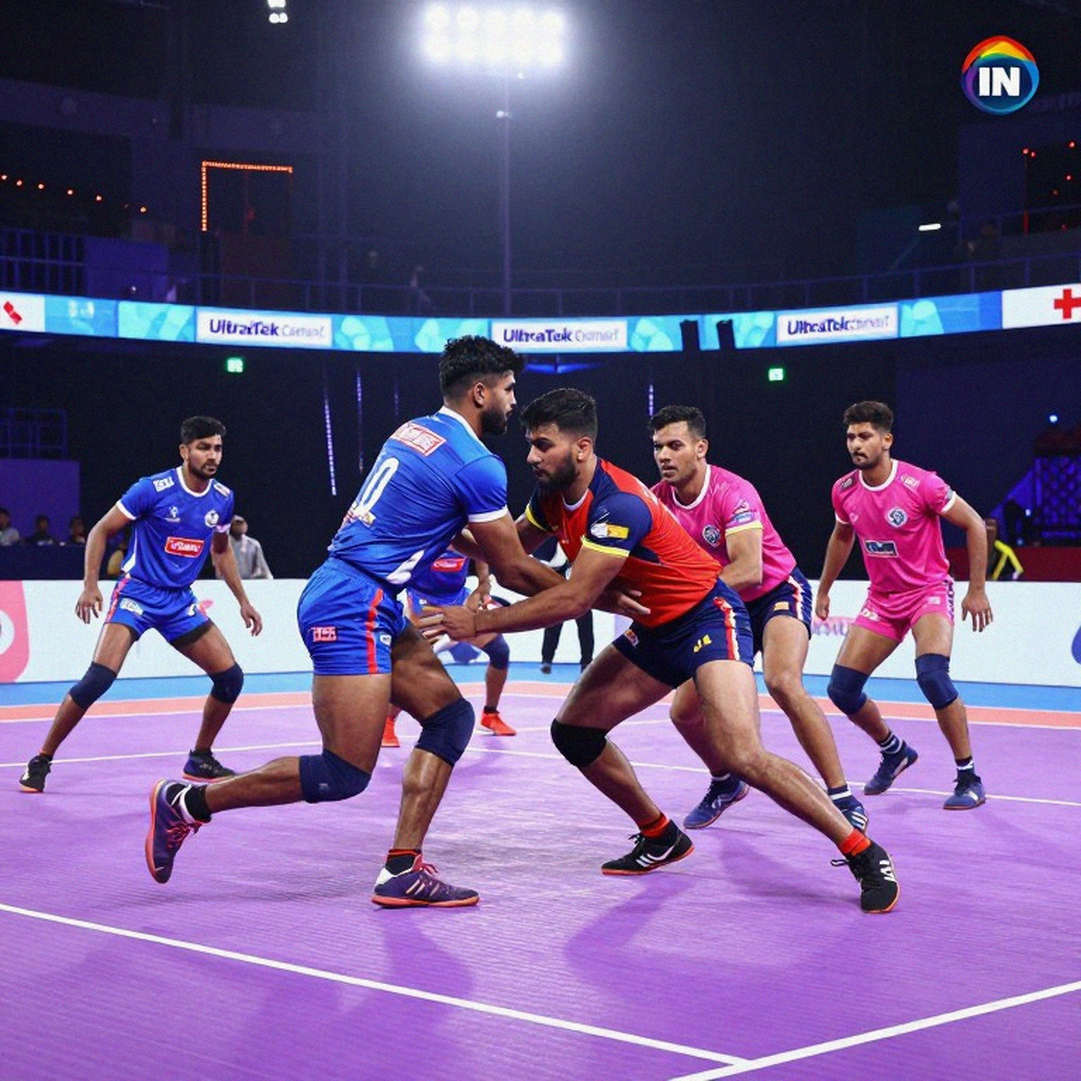
The Commonwealth Kabaddi Championship 2026 is being played in Ahmedabad. The men's draw has 13 teams across two groups — seven in Group A, six in Group B. Round-robin group stage, then the standings; wins first, score difference second.
"Commonwealth" here is a membership label, not a sanction from the Commonwealth Games Federation. Kabaddi is not on the Commonwealth Games programme — I write that because the sentence starts circulating around every large tournament. And that label decides who is in this table and who is not. Iran is not. The sport's second power, the country that broke India's men's gold monopoly at the Asian Games, the country whose defender Fazel Atrachali has taken more tackle points than anyone in PKL history — Iran is not a Commonwealth member, so it is not in this table. South Korea is not either. The table we are calling international is missing the world's second and third strongest sides.
Group A: Sri Lanka 48-21 (+27), India 46-26 (+20), Uganda 45-29 (+16). All three won, all three have different margins, the order is clean. Group B: Scotland 59-30 (+29), Kenya 48-28 (+20). I back-calculated it — every winning margin in the table checks out against the score. The factual layer is reliable. What does not check out is what the table means.
Bangladesh's third place in Group B badly understates its actual strength. It has not played, so its difference is zero, and zero has parked it below Kenya and Scotland but above the teams that lost. On paper that is correct. On paper it is also meaningless. Bangladesh is very probably the strongest side in that group, and the Day 1 table is painting a false picture by seating it third.
Group A has seven teams, Group B six. In a full round-robin, every Group A side plays six matches and every Group B side five. In the smaller group, one big win can decide top spot, which makes running up the margin against a weak opponent the rational strategy. 59-30 is not a kabaddi story; it is a table incentive. Scotland did what every sensible team does — stretched the margin against Australia, because here the margin is the ranking.
The only individual number on Day 1: Scotland's Lovepreet Brar, 23 raid points. That is a fine performance. It is not proof. Twenty-three points are at least 39 per cent of the team's 59, and since a team total also includes tackle points, bonus points and All Out points, his share of the raid points specifically must be above half. Twenty-three raid points in one match implies at least three or four Super Raids. Excellent. But it came against Australia — the weakest defence of the day, the one that leaked 59.
A single match against the weakest defence does not establish a raider's level. In PKL analytics, one match sits inside the noise band; a stable level needs eight to ten matches or a full season. I am aiming this at my own trade's habit: the breakout-star headline should not be built on this one innings.
The name carries information too. Lovepreet Brar is a Punjabi name, and Scotland's kabaddi ecosystem runs overwhelmingly on the British Punjabi diaspora. Diaspora kabaddi is culturally rooted in circle style — a circular field, one-on-one offence and defence, the rural Punjab game. Standard style demands 7v7 positional defence, the bonus line and thirty seconds of cant discipline. That adaptation gap is the most under-reported story in diaspora kabaddi, and it is a plausible explanation for the 89-point match — loose structural defence on both sides.
India beat England 46-26. A twenty-point margin is solid but not dominant by India's standards — Sri Lanka's margin (+27) was bigger. And here is the variable the report does not carry: which squad? Senior national team, or a domestic/development side? Without that, 46-26 supports no conclusion at all. Not one Indian player's individual stat appears anywhere in the report — that editorial choice is itself a signal that this was compiled from a results sheet rather than reported from the mat.
Kenya beat Singapore 48-28, Uganda beat Malaysia 45-29. In the standard internationalisation narrative, African teams are participants, not competitors. Two African wins on the same day is a small signal. The correct conclusion is "worth tracking," not "power shift." I am stopping my own disease here.
What is nowhere in the report: is this standard style or circle style? What are the qualification rules — top two, top four, semifinals? Not knowing that means we cannot price the strategic value of score difference. And for Scotland, England, Canada and Australia — the four sides leaning towards circle-style diaspora kabaddi — we do not know the officiating standard either.
Now the part where I build the case against myself.
I reverse-engineered the ranking rule from the table — wins, then difference. It is internally consistent, and internally consistent is not the same as correct. Qualification could be top-two with the difference mattering less than I assume; if so, my entire running-up-the-margin structure collapses.

Second, my sample is five matches and one individual number. Five. And one. When I write about a call, I put the sample size in the sentence, not the footnote — so: n=5, individual data n=1. Calling Bangladesh the strongest side in Group B is my inference, not my data. It could be wrong by tomorrow, and if it is, I will write it as loudly as I am writing this.
Third, the semi-automated, desk-compiled reading is also an inference. The reporter may have been at the venue with no individual data available. The difference is that I am making that claim as probability, not as fact.
And fourth — probably the most important. I have made Iran's absence the biggest issue in this piece. That is the easy road, because it is true and because I have been writing it since 2026. But it is not the organisers' job to invite Iran; Commonwealth membership is not in their hands. The table's real problem is not that Iran is missing. It is that the table's account of itself is incomplete.
So what do we watch from tomorrow? Three things, all on the record.
One — whether Bangladesh wins its first match, and by how much. If it does not finish top of Group B, my inference was wrong.
Two — Lovepreet Brar's second match. Another 15-plus raid-point haul means the 23 was not just Australia's defence. Eight means Day 1 was a good innings, not a rise.
Three — whether any official statement confirms standard style and the qualification route. If none comes, we are reading the table of a tournament whose rules we do not actually know.
In 2026, at the TransStadia in this same city, everyone repeated the final score 38-29. The real work that night was the second-half tackle economy. My 900 words were cut to 150, but the number survived. This time the number is this: three teams are sitting mid-table without having played. Until they play, this table is not a photograph. It is a wait.