
Asian CricketRecord at Eden Park: New Zealand Post 259/7 as India Slip to 87-Run Defeat, Series Still 3-1 in India's Favour
Record at Eden Park: New Zealand Post 259/7 as India Slip to 87-Run Defeat, Series Still 3-1 in India's Favour
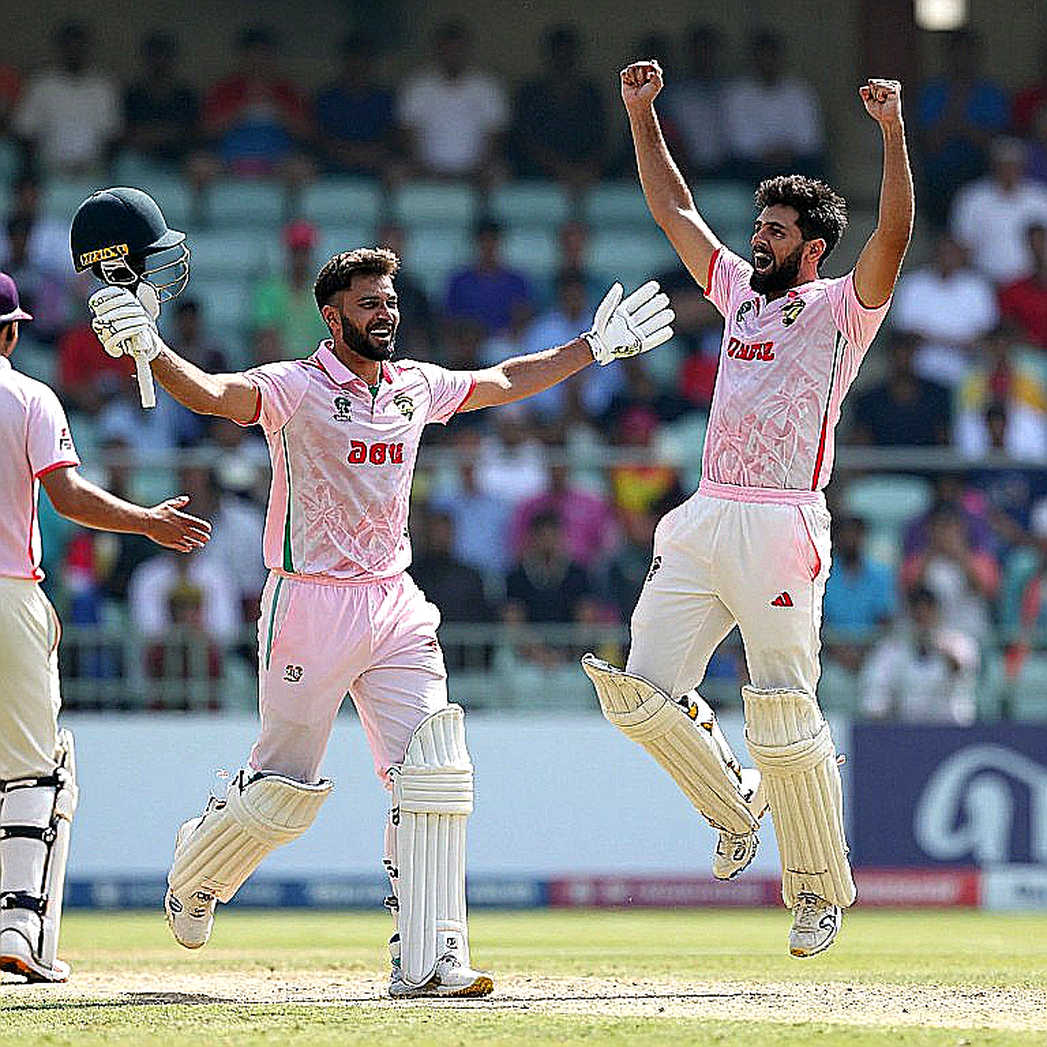
न्यूजीलैंड ने ऑकलैंड के ईडन पार्क में भारत के खिलाफ T20I में 20 ओवर में 7 विकेट पर 259 रन बनाए और भारत को 9 विकेट पर 172 रन पर रोककर 87 रन से जीत दर्ज की। यह सीरीज का चौथा मुकाबला था; इससे पहले भारत 3-0 से आगे था और सीरीज जीत चुका था, इसलिए यह सांत्वना जीत है और सीरीज स्कोर अब 3-1 है। ग्लेन फिलिप्स ने 49 गेंदों पर 107 रन बनाए (6 चौके, 10 छक्के, स्ट्राइक रेट 218.4, 78.5% रन बाउंड्री से), माइकल ब्रेसवेल ने 25 गेंदों पर 65 रन (स्ट्राइक रेट 260.0) बनाए और दोनों के बीच 41 गेंदों पर 115 रन की साझेदारी हुई; न्यूजीलैंड ने 16 ओवर के भीतर 200 रन पार किए। जैकब डफी ने 4 ओवर में 23 रन देकर 4 विकेट लिए (इकॉनमी 5.75, स्ट्राइक रेट 6.0) और मिचेल सैंटनर ने दो विकेट लिए। भारत का पावरप्ले ढह गया — पहले ओवर में 4 गेंदों के भीतर 2 विकेट पर 4 रन और एक समय 6 विकेट पर 89 रन; तिलक वर्मा (35) और नामन धीर (28) ने केवल अंतर कम किया। ध्यान दें: 259/7 भारत के खिलाफ सर्वोच्च T20 स्कोर बताया गया है (इंग्लैंड का 257 पुराना रिकॉर्ड), लेकिन यह दावा स्वतंत्र रूप से सत्यापित नहीं है; साथ ही स्रोत में 'मैथ्यू फिशर' को न्यूजीलैंड का गेंदबाज बताया गया है, जो संभवतः त्रुटि है। ईडन पार्क की छोटी बाउंड्री ने स्कोर और छक्कों को बढ़ावा दिया, इसलिए नतीजे को अन्य मैदानों पर सीधे विस्तारित नहीं किया जाना चाहिए।
New Zealand beat India by 87 runs in the Twenty20 international at Eden Park, Auckland, after posting 259 for 7 in their 20 overs and then restricting the visitors to 172 for 9. It was the fourth match of the series, and India had already sealed the contest by taking a 3-0 lead beforehand. Even after this win, New Zealand trail the series 3-1, which means the result cannot alter the outcome of the series.
The context matters more than the margin. With the series already decided, this was a consolation victory for New Zealand and, for India, a match in which both top-order fragility and death-bowling concerns surfaced at the same time. A total of 259 and a margin of 87 runs are substantial by themselves, but drawing sweeping conclusions about the relative strength of the two sides from a single dead rubber would be premature.
The shape of the scorecard tells two very different stories. New Zealand lost seven wickets across 20 overs, which means their scoring rate never stalled and they were never under sustained pressure. India lost two wickets inside the first over and finished with nine down. The bulk of the defeat was effectively settled in the first six overs.
The standout performance came from Glenn Phillips, who made 107 off 49 balls with six fours and ten sixes, a strike rate of 218.4. That is an elite figure by any T20 benchmark. More importantly, 84 of his 107 runs, or roughly 78.5 per cent, came in boundaries. This was not an innings built on running and rotation; it was built on clearing the rope, a model that works on small grounds and translates far less reliably elsewhere.
Michael Bracewell's contribution should not be reduced to a supporting role. He made 65 off 25 balls at a strike rate of 260.0, including four fours and six sixes, with 52 of his 65 runs, or 80 per cent, coming in boundaries. Had his innings been slower, New Zealand would likely have settled around the 200 mark.
The 115-run partnership between the two, compiled in just 41 balls, was the decisive phase of the match. That works out to roughly 2.8 runs per ball, a period India's bowlers never controlled. On the back of that stand, New Zealand crossed 200 inside 16 overs, which gave them the freedom to expand without risk in the closing four overs.
There is a sustainability question attached to New Zealand's total. Phillips and Bracewell carried such a large share of the scoring that the remaining batters only had to hold up an end. Had either fallen early, a total of 259 would have been difficult to reach.
Jacob Duffy produced the standout bowling return: 4 overs, 23 runs, 4 wickets, an economy rate of 5.75 and a bowling strike rate of 6.0 balls per wicket. Anything under seven runs an over is excellent in T20 cricket, and it matters even more in a match where the opposition reached 172. Duffy struck in the first over and again around the 12th, meaning he had an impact with the new ball and in the middle overs alike. That dual impact was the foundation of New Zealand's win.
Mitchell Santner chipped in with two wickets, but a source-quality caveat is necessary here. The available match detail also records that 'Matthew Fisher and Mitchell Santner took two wickets each.' Matthew Fisher is an England bowler, not a New Zealander. The name is clearly inconsistent and the bowling card should be verified against the official scorecard before being cited.
India's innings began disastrously. Sanju Samson and Ishan Kishan were both dismissed within four balls inside the first over, leaving the score at 2 for 4. The pressure never eased, and at one stage the side had collapsed to 6 for 89. Chasing 259 from that position is mathematically almost impossible, and that is precisely what unfolded.
Abhishek Sharma made 27 and Shreyas Iyer 22 at the top of the order, but neither converted a start into a substantial innings. Lower down, Tilak Varma's 35 and Naman Dhir's 28 reduced the margin, but those were cosmetic contributions rather than match-altering ones. India's batting depth is not fully disproven by this match, but the top order was clearly exposed against the new ball.
The venue is a significant factor. Eden Park's short boundaries and batting-friendly dimensions inflate totals of this kind, and Phillips's six-hitting has been directly linked to those short boundaries. The practical implication is that both the 259 and the six count are partly a product of this ground; the same batting performance may not produce 259 on a larger field. Any assessment of individual form must separate the venue effect.
Caution is also warranted on the record claim. According to the available information, 259 for 7 is the highest T20 total against India, surpassing England's 257. This is framed as a record against India specifically, not as a global T20I record. Since the comparison has not been independently verified, it should be treated as provisional until checked against official record tables.
On whether this defeat signals a deeper problem for India's T20 side, the answer is no. India had already wrapped up the series at 3-0 and carried no pressure into this match. In such circumstances, experimentation, workload management and trying new combinations are natural. The available report does not list the XI or confirm any changes, so this cannot be stated as fact, but the dead-rubber context makes rotation plausible and reduces the diagnostic value of the loss.
That said, questions about India's death bowling are fair. Conceding 259 in one match does not establish a trend, but it does indicate that plans did not hold under pressure. Similarly, a powerplay collapse to 2 for 4 raises questions about top-order contingency planning. Both issues should be judged on data from the next three to five matches.
For New Zealand, the win is valuable for confidence and home record, but its impact on rankings or on the series outcome is limited because the series was already lost. The genuine positive is that the team appears to have found an aggressive middle-order six-hitting pair in Phillips and Bracewell, capable of breaking opposition bowling on small grounds.
There are clear signals to track from here. First, the result of the next match in the series: if New Zealand win again, the narrative shifts from consolation to momentum. Second, India's top-order selection: a change in the opening pair would confirm the concern. Third, India's death-overs economy: if they continue conceding more than ten an over, the weakness becomes structural rather than incidental. Fourth, Phillips and Bracewell's returns on larger grounds: a sharp drop in six-hitting would confirm the venue effect. Fifth, source verification: the bowling card should be confirmed against the official scorecard.
On terminology, a few clarifications are useful. The powerplay is the first six overs of a T20 innings, played under fielding restrictions. The death overs are generally overs 16 to 20, when batters attack most. Strike rate means runs per 100 balls for a batter and balls per wicket for a bowler. Economy rate is runs conceded per over. Boundary share is the proportion of a batter's runs scored in fours and sixes. A dead rubber is a match whose series outcome has already been decided. DLS refers to the Duckworth-Lewis-Stern method for rain-affected matches; no weather information is available here, so its influence cannot be assessed. Toss, weather and dew details are also unavailable, which limits a full assessment of fairness.
Finally, this analysis rests on publicly available information and the facts of the match report. It includes a likely player misattribution in the bowling card and an unverified record claim, so conclusions should be treated as provisional until confirmed against the official scorecard. This material is provided for sports-information purposes only and does not constitute betting advice of any kind. Sporting outcomes are highly uncertain and analytical conclusions should be read rationally.
संबंधित खिलाड़ी
अनुशंसित
After the Scorecard: The Asian Cricket Beat That Never Makes the Record2026-10-30
Ranji Trophy Semi-final: Shreyas Gopal's Fourth Morning and the Unreported Story of Karnataka's 'Turn'2026-10-27
Wellington's 13.2 Overs: Abhishek Sharma's 113 off 38 Balls as India Chase 199 and Seal the Series 3-02026-10-28
The Empty Payload: A Cricket Desk, Nine Blank Fields, and the Report That Refused to Be Written2026-10-30
The Empty File and the Full Market: Where a Transfer-Window Story Is Built, and Where It Breaks2026-10-25
Two Seconds, One Review and Shadab Khan's Second Life: The Numbers That 'Hunger' Cannot Explain2026-10-28
अनुशंसित
Cameron Green Returns for Newlands Decider: A Batting Boost With a Fifth-Bowler Gap2026-10-27
Mirpur, 74 Overs, 2.88 an Over: Sadman's 99* and the Scorecard That Hides a Fourth Batter2026-10-29
Null Payload: How Cricket's Story Machine Returned 1,060 Words and Not One Fact2026-10-25
The Scorecard Is Complete. The Account Is Missing.2026-10-30
Saim Ayub Released: The 21-Run Ledger, a Captain's 24-Hour Reversal and Farhan's Format Mismatch2026-10-27
Starc's Devastating Spell Triggers South Africa Collapse as Australia Fight Back at Newlands2026-10-28
Pink Ribbons and a White Ball: The Real Scorecard of Pakistan vs England in Lahore2026-10-30
अनुशंसित
53 in 2.2 Overs: The Number That Never Made the Scoreboard in India's 40-Ball Chase2026-10-28
Sirajuddin's six and Jamal's 6/14: SBP lead MIT by 24 in President's Trophy final, but the game remains open2026-10-28
Steffan Jones Joins Mumbai Indians as Bowling Consultant: The Pace Project and the Evidence That Isn't There Yet2026-10-25
Rising Stars Asia Cup 2026: Bangladesh A's Draw Is Favorable, but the Silence in the Data Is the Real Signal2026-10-25
Four Spinners, Two Seamers and an Unstated Format: Reading Muneeba Ali's Pakistan Squad as a Balance Sheet for Ajman2026-10-28
An Empty File at a Full Deadline: When a Cricket Story Reaches the Desk Without a Single Fact2026-10-28
MI's Coaching Audit: McClenaghan Inherits Malinga's Chair, and a New One Called 'Development'2026-10-30