
Pakistan Withdraws from Commonwealth Kabaddi Championship 2026; India's Dominance All But Assured in 13-Team Field at Ahmedabad
मुख्य तथ्य एक नजर में: पाकिस्तान का पुरुष कबड्डी दल पहली कॉमनवेल्थ कबड्डी चैंपियनशिप (23–31 अक्टूबर 2026, वीर सावरकर स्पोर्ट्स कॉम्प्लेक्स, अहमदाबाद) से देर से हट गया, जिससे मैदान 14 से 13 टीमों का रह गया। ईरान (कॉमनवेल्थ सदस्य नहीं) और चीनी ताइपे भी भाग नहीं ले रहे, इसलिए भारत के सामने कोई वास्तविक चुनौती नहीं बची। भारत ने एशियाई खेल 2026 में पुरुष और महिला दोनों वर्गों में स्वर्ण जीता, जबकि पाकिस्तान किसी पदक तक नहीं पहुंचा — रिपोर्ट में इसे कबड्डी में उसका पहला पदक-रहित एशियाई खेल बताया गया है, पर यह दावा एशियाई ओलंपिक परिषद के रिकॉर्ड से सत्यापित नहीं है। पाकिस्तान के हटने का कारण किसी भी रिपोर्ट में नहीं बताया गया — प्रशासनिक, वीजा-संबंधी या प्रदर्शन-आधारित, तीनों संभावनाएं खुली हैं। खेल-तकनीकी दृष्टि से सबसे महत्वपूर्ण बिंदु यह है कि कॉमनवेल्थ चैंपियनशिप का नियम-संस्करण (स्टैंडर्ड स्टाइल या सर्कल स्टाइल) स्पष्ट घोषित नहीं है; अगर यह स्टैंडर्ड स्टाइल है, तो पाकिस्तान का पतन 'फॉर्म' की समस्या नहीं बल्कि प्रारूप-रूपांतरण की संरचनात्मक समस्या है, क्योंकि सर्कल स्टाइल की परंपरा से उपजे रेडर और रक्षक स्टैंडर्ड स्टाइल की बहु-रक्षक संरचित रेड और कॉर्नर-कवर अनुशासन में पीछे रहते हैं। दूसरा संरचनात्मक बिंदु यह है कि 'कॉमनवेल्थ' ढांचा अपनी बनावट से ईरान को बाहर रखता है — यानी वह टूर्नामेंट जिसमें भारत को हराने में सक्षम इकलौती टीम शामिल ही नहीं हो सकती। इस आयोजन की प्रतिष्ठा 'अनंतिम' मानी जानी चाहिए, क्योंकि यह उद्घाटन संस्करण है, शासी निकाय स्पष्ट नहीं है और मैदान कमजोर है। इन सभी कारणों से पाकिस्तान की वापसी को केवल राजनीतिक कदम न मानकर प्रतिस्पर्धी और प्रारूप-संबंधी कारणों के साथ पढ़ना जरूरी है।
The inaugural Commonwealth Kabaddi Championship, scheduled at the Veer Savarkar Sports Complex in Ahmedabad from 23 to 31 October 2026, has been reduced from a 14-nation field to 13 after the late withdrawal of Pakistan's men's team. The pull-out comes at the weakest point in Pakistan's modern kabaddi history, immediately after the side finished the 2026 Asian Games without a single kabaddi medal. Reports available do not state why Pakistan withdrew — whether the decision was administrative, tied to clearances or visas, or the result of a competitive assessment. In the absence of a stated reason, treating the withdrawal as purely political or purely performance-driven would both be incomplete conclusions.
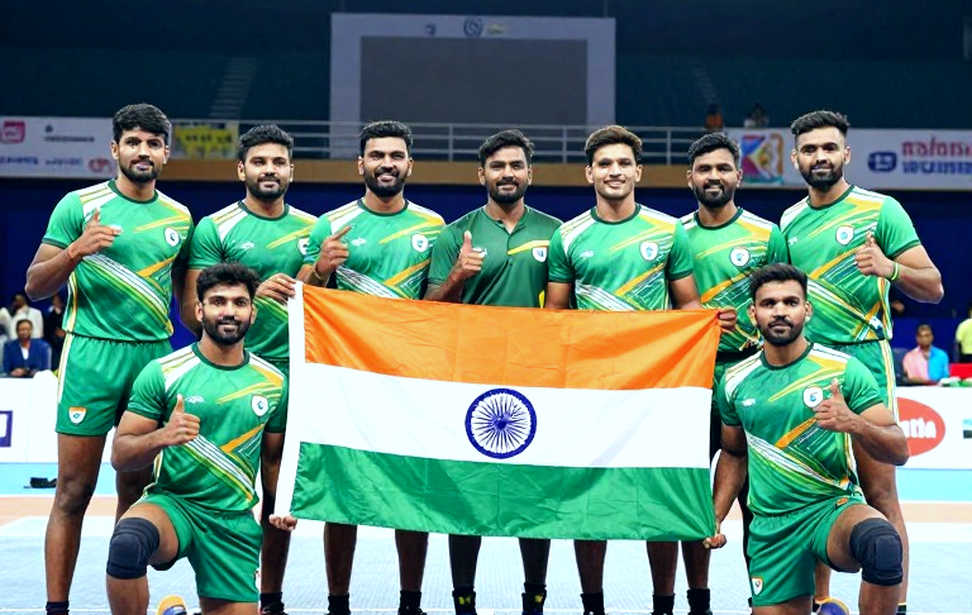
India's double gold and Pakistan's empty hand
At the 2026 Asian Games, India won gold in both the men's and women's events. The result has been read as a demonstration of Indian dominance. The same reports note that India's Asian Games gold came in Iran's presence — that is, with the one team widely regarded as India's only genuine rival in the sport on the mat. Pakistan, by contrast, did not reach any medal in kabaddi. The report further claims that this is the first time Pakistan's long unbroken run of at least a bronze in Asian Games kabaddi has been broken. That claim has not been independently verified against Olympic Council of Asia records and should be treated as data pending verification, since Pakistan has featured on the Asian Games kabaddi podium at bronze and silver level in earlier cycles. What is less disputed is that the 2026 Asian Games were a disappointment for Pakistan and that its medal record was broken.
A hollowed field: Iran and Chinese Taipei also absent
The real story of the Commonwealth Championship is not Pakistan's withdrawal alone. Iran and Chinese Taipei are both not participating. Iran's absence is structural rather than accidental — it is not a Commonwealth member. But the consequence is that the world's second-best team and a traditional Asian kabaddi power are both missing. With Pakistan also out, no side remains that poses a genuine threat to India. In this context, the observation that Pakistan had a good medal opportunity is technically defensible: the field was thinned by Iran's and Chinese Taipei's absence. But the same logic cuts the other way — a thinned field makes India's dominance unopposed, and Pakistan has not beaten India in Standard Style competition in the modern era. Read together, Pakistan's withdrawal looks not only like a forfeited opportunity but like an exit from a fixture it was unlikely to win even on paper.
The rules first: what kabaddi actually is
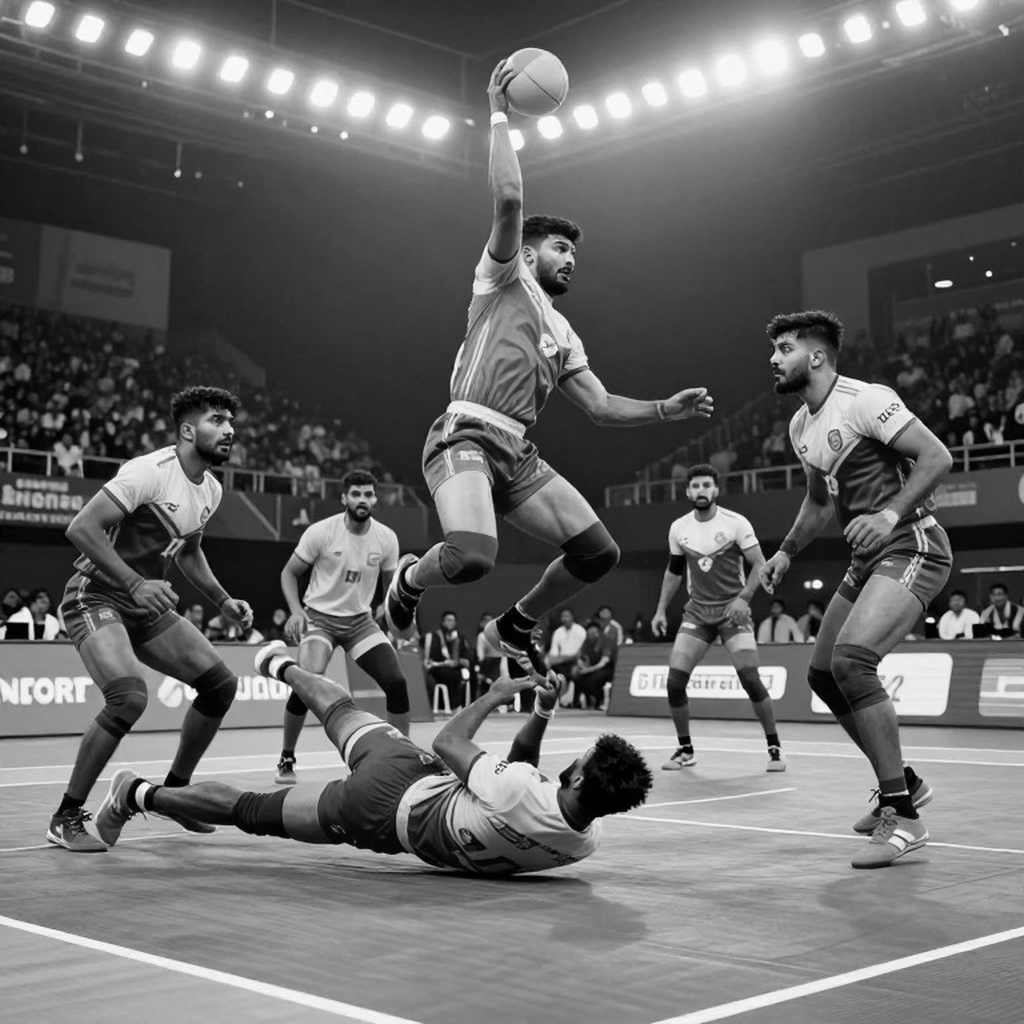
The rules are intuitive to subcontinental readers, but they matter to everyone else, because the key to reading this tournament's outcome lies in the rulebook. Kabaddi is a 7-vs-7 contact sport played on a 13m × 10m court, in which one attacker at a time enters the opposing half — best imagined as a full-contact version of the eagle-catches-chicks game combined with wrestling. In a raid, the attacker must touch at least one defender and return to his own half within 30 seconds. Throughout the raid he must continuously chant "Kabaddi… Kabaddi…" to prove he is not taking a breath. This 'cant' rule makes kabaddi perhaps the only mainstream sport with a built-in breath clock, and it is why most raids last 15 to 20 seconds at most.
Scoring looks simple but the impact is deep: one point for a touch, one for crossing the bonus line, one for a tackle, two for a Super Tackle (a tackle made with three or fewer defenders on court), and two for an All Out, with full revival of the eliminated team. Point values are small, so a seven-point lead is never safe. The Do-or-Die raid — the third raid after two empty raids must score, or the raider himself is out — exists to punish stalling.
The real issue: Circle Style versus Standard Style
One thing this report never clarifies is which rule variant the Commonwealth Championship uses. The Ahmedabad venue and the pairing with the Asian Games suggest Standard Style — rectangular court, seven a side, internationally governed — but that is an inference, not a stated fact.
The distinction is decisive. Circle Style is played on a circular field, often with eight players a side, and dominates rural Punjab on both sides of the India–Pakistan border. In Circle Style a raider can retreat without penalty; in Standard Style he cannot. The Do-or-Die rule also differs. The result is that raiders raised in the Circle Style tradition are excellent in one-on-one evasion but lag in structured, multi-defender Standard Style raids and in disciplined corner-cover defensive systems. The bonus line sharpens the gap: crossing it while the defence has six or more players on court earns a point — a weapon that punishes passive deep defending. A team without a bonus-line raider is pushed into low-percentage touch raids, a profile that matches Pakistan's recent Standard Style outings.
The silence of statistics
The most important fact in this whole discussion is a non-fact: not one of the reports carries a single performance statistic. No raid points, no successful raid percentage, no tackle success rate, no squad composition, no player names. A binary outcome like "failed to reach the semi-finals" cannot establish whether the raiding failed or the defence collapsed. Any tactical diagnosis of Pakistan's decline is therefore inference, not analysis.
What can be inferred is a portfolio failure rather than a star failure. Pakistan has no Pro Kabaddi League platform, no overseas club pathway, and a domestic circuit dominated by Circle Style. Such a system does not produce Standard Style corner and cover specialists — and modern matches are decided in exactly those two positions.
India's advantage is structural
India's double gold is not an upset but a structural outcome. A PKL-trained, data-coached system with a bench of more than twenty international-standard players produces replaceability at every position. The real risk for India is not losing but the absence of a challenge — because playing without pressure ahead of Iran-facing fixtures dulls sharpness.
The ceiling built into the word 'Commonwealth'
Kabaddi's global hierarchy is clear: India, then Iran, then everyone else. Iran is not a Commonwealth member. The direct implication is that the Commonwealth Championship is, by construction, the one tournament that cannot contain the only team capable of beating India. That is a design flaw, not a scheduling accident. The event's prestige also deserves scepticism: it is an inaugural edition, its sanctioning body is not publicly clear, and the field is weak. Such events are routinely over-labelled in South Asian media. Until the sanctioning authority is confirmed, its prestige should be rated provisional.
Commercial damage and a domestic collision
Of the three absences, Pakistan's is commercially the most damaging. Without Iran the standard of play falls, but without Pakistan the one fixture with genuine emotional and broadcast pull — India versus Pakistan — disappears. The 23–31 October dates also collide with the PKL's traditional October–December broadcast window, raising a direct question over the availability of Indian players.
What actually matters
International kabaddi's structural problem is event scarcity, and Pakistan's withdrawal makes it worse, not better. Each forfeited appearance costs a national programme a disproportionate share of its annual development value. Pakistan's exit from the Commonwealth Championship therefore tells two stories at once: that of a team struggling with a format gap, and that of a competition that cannot, by its own design, produce a top-tier contest. What is missing from both is verified information.